The labor market is currently changing from an employee market to an employer market, although the actual characteristics vary depending on the industry. Companies must therefore adapt to a changed dynamic that presents both challenges and opportunities. The following still applies: with a shortage of skilled workers and demographic change, HR and employer branding is not a nice-to-have, but remains a strategic necessity in the competition for the best employees.
But what actually distinguishes an average HR and employer branding campaign from one that has a lasting effect and achieves measurable success? Based on our many years of experience and expertise as an agency, 7 decisive success factors have crystallized in practice …
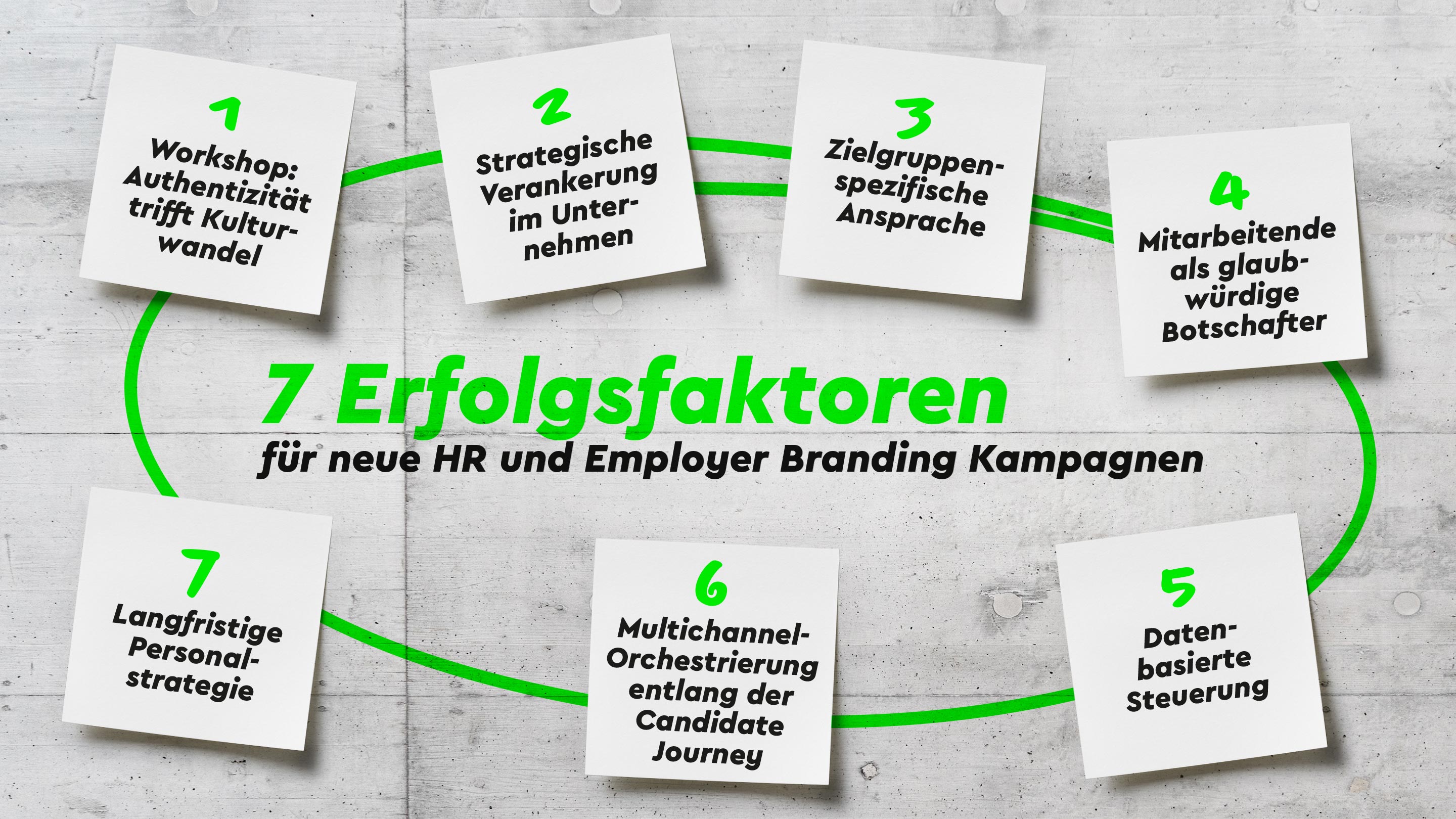
The days of interchangeable “We are a great team” messages are definitely over. A successful HR and employer branding campaign is based on an honest assessment of the corporate culture and value proposition. This is because potential applicants prefer to gather information on open career platforms and in closed communities – any discrepancy between promise and reality is mercilessly exposed.
Our recommendation: Before launching a campaign, the agency should ideally hold a joint workshop with representatives from the HR department of the respective company. Central questions on the topics of authenticity and cultural change are answered honestly. For example: What do current employees value about the company as an employer? And where is there potential for improvement in terms of appreciation, flexibility and self-realization? These findings then form the basis for credible communication that takes into account and directly addresses the wishes and needs of the new generation of applicants.
In principle, HR and employer branding is not a marketing initiative, but part of a holistic management approach. The basis for the success of an employer branding campaign is therefore a triad of C-level commitment, cross-functional collaboration and clear governance.
In addition, a successful campaign should always be embedded in a company’s overall marketing strategy and harmonize with the corporate brand, product marketing and internal communication. This is the only way to create a consistent brand experience across all touchpoints and communication channels that strengthens the brand in the long term.
When it comes to talent acquisition, the specific requirements and needs of individual target groups often differ fundamentally from one another. Successful HR and employer branding campaigns therefore do not rely on a pragmatic one-size-fits-all approach, but segment precisely and individually in advance. For example, according to:
– Persona clustering: demographic characteristics, career level, specialist area
– Psychographic factors: Values, motivations, life phases
– Journey stages: Passive talents vs. active seekers, students vs. university graduates, etc.
Expert tip: Depending on qualifications and generation, tailor-made messages, formats and channel strategies must be developed for each individual target group. After all, a senior software engineer on LinkedIn needs to be addressed differently than a marketing trainee on Instagram.
On average, user-generated content from employees achieves a significantly higher engagement rate in recruiting than traditional corporate communication. Successful HR and employer branding campaigns therefore integrate and orchestrate systematically:
– Authentic stories from employees: Video testimonials, day-in-the-life formats, behind-the-scenes content
– Structured ambassador programs: Selected employees as brand ambassadors with training and guidelines
– Social selling integration: employees as content distributors in their own network
The decisive factor here is that participation must be voluntary. And employees need real creative freedom within clearly defined guidelines from the agency in order to fulfill their function as credibility multipliers.
What is already standard in performance marketing is often still missing in HR and employer branding: data-driven control and consistent measurability. Successful campaigns therefore define and measure right from the start:
a. Leading Indicators:
– Reach and impressions by target group
– Engagement rates and sentiment analyses
– Traffic to career site and time-on-site
– Application rate and quality-of-hire metrics
b. Lagging Indicators:
– Cost-per-application and cost-per-hire by channel
– Onboarding success rates
– Retention rates of new hires
– eNPS (Employee Net Promoter Score) over time
Our additional expert recommendation: A/B testing of creatives, landing pages and application processes creates a continuous optimization and improvement cycle that pays off in the long term.
Today, the candidate journey comprises an average of 15 to 20 touchpoints. And this takes place over a period of several weeks to months. A successful HR and employer branding campaign therefore considers four coordinated journey phases from the outset:
Seamless multichannel orchestration across owned, earned and paid media is crucial – naturally always with a consistent message in the agency’s channel-specific preparation.
HR and employer branding are a marathon, not a sprint. The most sustainable success is achieved by campaigns from companies that focus on a long-term HR strategy and consistently build their employer brand over the years – while still reacting flexibly to market changes at all times.
This means regular refresh cycles, responding to social trends (sustainability, diversity, new work, etc.), integrating new channels and formats and continuously developing the corporate culture.
The best HR and employer branding campaign does not develop its impact in a vacuum, but as an integral part of a living corporate culture. It combines strategic thinking with creative excellence, uses data for control and consistently focuses on people – as potential employees and as brand ambassadors.
If you take these principles to heart and provide them with sufficient budget, patience and authenticity, you will not only create a successful HR and employer branding campaign, but also build a strong employer brand that has great appeal even in volatile times. Both externally and internally – because retaining motivated employees is always better than attracting new ones!
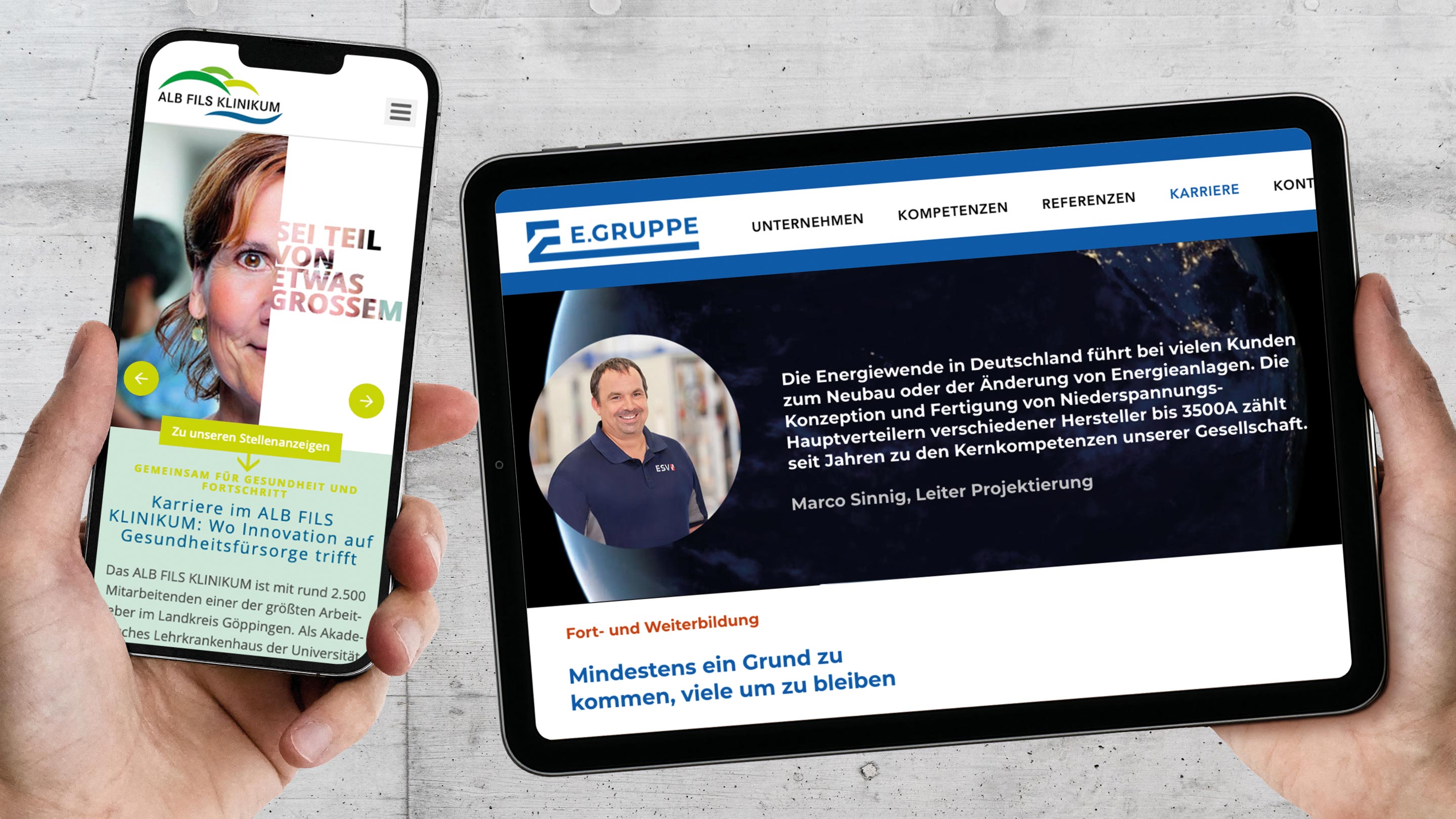
From the specialist portal for the East Württemberg region to the Alb Fils Klinikum and the LET Group to Scholz Recycling GmbH and Rommelag SE & Co. KG: Selected examples of successful HR and employer branding campaigns from our agency’s day-to-day work can be found on our website:
A successful HR and employer branding campaign is based on an honest assessment of the corporate culture and value proposition.
If the HR and employer branding campaign is embedded in the company’s overall marketing strategy and harmonizes with the corporate brand, product marketing and internal communication.
Preferably according to persona clusters, psychographic factors and journey stages.
For example, through authentic stories from employees, structured ambassador programs and a functioning social selling integration.
– Reach and impressions by target group
– Engagement rates and sentiment analyses
– Traffic to career site and time-on-site
– Application rate and quality-of-hire metrics
– Cost-per-application and cost-per-hire by channel
– Onboarding success rates
– Retention rates of new hires
– eNPS (Employee Net Promoter Score) over time
LinkedIn ads, programmatic display, content marketing, influencer cooperations
SEO-optimized career site, HR and employer branding videos, webinars, podcast appearances
Mobile-optimized application process, chatbots for real-time support, clear communication of next steps
Pre-boarding programs, mentoring, continuous feedback