
The PPWR Regulation fundamentally changes the requirements for packaging. This article shows how packaging is realistically evolving amid the conflicting demands of regulation, production, branding, and design—and what role agencies actually play in this process.
Sustainable packaging is often reduced to a simple equation: paper is good, plastic is bad, and recycling is the goal.
In an industrial context, this perspective falls short. Packaging is not an isolated design element, but rather the result of a complex interplay between materials science, production technology, logistics, regulation, and brand management.
The EU Packaging and Packaging Waste Regulation (PPWR 2025/40) now formally establishes this system-based approach as a regulatory requirement. The regulation entered into force in February 2025 and will become mandatory in August 2026.
Their goal is clear:
The situation in Europe is clear:
The PPWR responds to this not with isolated adjustments, but with a comprehensive, system-wide approach that spans the entire life cycle of packaging.
For the first time, the regulation comprehensively addresses all relevant areas:
As a result, packaging is shifting from a design-driven product decision to a regulated industrial and compliance system.
In the practical development of packaging, it quickly becomes clear that no single player controls the system on their own.
Often, products have already been developed, technical specifications defined, or initial packaging solutions in place before the design process even begins.
Within this framework, packaging and design agencies play a specific role—though not as a central governing body.
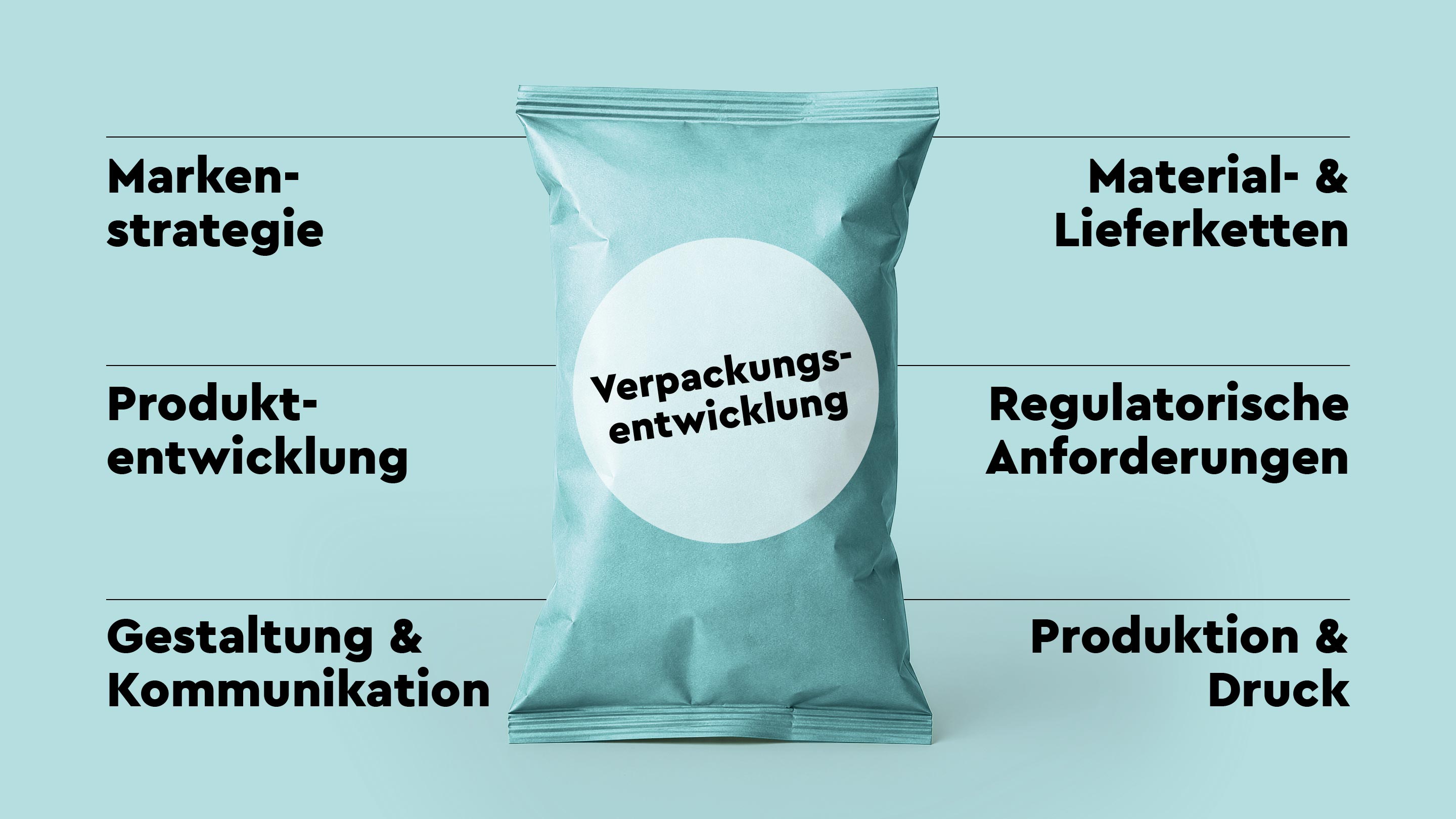
In practice, our role as an agency consists primarily of translating and creatively implementing existing guidelines.
Packaging systems are rarely one-dimensional. They become particularly complex when dealing with product lines or brand families.
Design work supports this primarily through:
Design thus functions less as a “source of ideas” and more as an agent of order and structure within complex systems.
In many projects, agencies are not brought on board until key parameters have already been defined:
The design work then takes place within these boundaries—as a refinement, clarification, and brand adaptation of existing solutions.
A key part of the agency’s work involves coordinating between different disciplines.
Packaging design serves as an interface between:
It is especially during the implementation phase that it becomes clear whether concepts work not only from a design perspective, but also from a technical and economic standpoint.
Two key issues in the sustainability debate remain outside the direct scope of design:
It is largely determined by material properties, logistics, and product requirements. In this context, packaging is primarily a protective system designed to prevent losses.
It depends on several factors:
Design can support these aspects, but it cannot define them on its own.
The PPWR makes it clear that packaging can no longer be viewed in isolation, but must be understood as an interconnected system comprising regulation, production, materials, and branding.
In this system, design does not play a central controlling role, but rather an important, yet clearly defined one:
Not as the center of decision-making—but as a unifying force between different system logics. Sustainable packaging does not arise from a single discipline. It emerges where different requirements are brought together—within an increasingly clear regulatory framework. And it is precisely in this act of translation that the real contribution of design in the context of packaging lies.
The EU Packaging and Packaging Waste Regulation (PPWR) establishes, for the first time, a comprehensive legal framework for packaging in Europe. It covers design, materials, production, recyclability, reusable systems, as well as labeling and producer responsibility.
The focus is on reducing packaging waste, increasing the proportion of recyclable packaging, expanding the use of recycled materials, and reducing the use of virgin raw materials. In the long term, the packaging system is to be aligned more closely with climate neutrality.
Packaging is the result of the interplay between materials science, production, logistics, regulation, and brand management. The PPWR reinforces this systems-based approach, as it regulates all phases of the packaging life cycle.
Packaging is increasingly becoming a regulated industry and compliance issue. Decisions are no longer driven solely by design considerations but must simultaneously take into account technical, environmental, and legal requirements.
Typically, several factors interact:
Agencies primarily operate within existing frameworks. They organize complexity, translate brand requirements into design, and bridge technical, regulatory, and communication requirements.
Design creates visual hierarchies, consistent product range logic, and clear information structures. This makes complex product families easier to understand and compare.
Was this article helpful for you? Do you have any questions or would you like to make an appointment? Simply contact us and let’s find out together how we can help you quickly.
Federal Environment Agency:
Generation and Recycling of Packaging Waste in Germany
The Packaging Act:
New European Packaging Regulations
DIHK: Fact Sheet: The New European Packaging Regulation (PPWR)
Information Sheet on Packaging Regulations (PPWR)
Environment & Sustainability:
Cradle to Cradle (C2C) – From Cradle to Cradle: A Sustainable Business Perspective












 back
back
 +49 7171 925290
 kontakt@eberle-werbeagentur.de


