

Effective POS activation therefore requires more than just attention. A successful POS display translates a strategic activation task into a visual decision-making aid: It helps people discover a product, quickly understand its relevant benefits, and make a choice. A good display is therefore not just additional advertising space, but rather supports a specific decision-making situation at the point of sale.
Shoppers don’t encounter a product placement without a backstory. They arrive with shopping goals, prior experiences, and often pre-existing brand preferences. Sometimes they’ve already decided on a specific product. Sometimes they’ve only decided on the category. In other situations, their interest is sparked only once they’re in the store. The point of sale is therefore part of a broader shopper journey. This journey begins with the emergence of a shopping need and extends through the purchase and use of the product all the way to repurchase and recommendation. This raises a key question for POS design: Which decision should the display help facilitate for which person in which shopping situation?
Not every display serves the same purpose. In practice, different activation tasks can be distinguished. A well-known brand may simply need to be brought to mind at the right moment. When consumers have a choice of brands, a relevant difference should be the deciding factor. An innovation must be discovered and quickly categorized based on consumer needs. Other activation mechanisms are designed to lead to additional use, a higher-value variant, or a complementary product.
These tasks present different design challenges. A reminder needs brand cues that are instantly recognizable. An innovation must make the category, need, and specific benefits as immediately clear as possible. A cross-selling idea, on the other hand, must quickly convey the connection between multiple products. Therefore, the first step is to clarify what the display is intended to achieve at the specific moment of purchase. Only once this objective is established can the message, design, and placement be determined in a targeted manner.
POS activation is often measured by how much it stands out in the retail environment. However, what is more crucial to its effectiveness is whether it makes it easier for shoppers to make a choice at the right moment. A good display therefore guides shoppers in just a few steps from their relevant need to the right product. Which information should be noticed first is determined primarily by the activation task. This must also be tailored to the specific shopping situation. For example: If a new non-alcoholic beverage brand is to be launched, it’s not enough to simply place the packaging as prominently as possible. The display must quickly convey what kind of product it is, what need the beverage addresses, and why it’s worth trying the new product. At the same time, the brand must be clearly and unmistakably recognizable so that the activation not only encourages people to try the product but also builds brand awareness. It is important to note that effective activation fundamentally reduces the complexity of the decision: it organizes content, sets clear priorities, and makes the next step understandable.
At the point of sale, a display competes with products, packaging, prices, and other stimuli. That’s why every design needs a clear visual hierarchy. The visual sequence may vary depending on the task. For a new product launch, the specific need may be the deciding factor. For a price promotion, the promotional mechanism takes center stage. There is no universally correct order. What matters is that the planned sequence actually materializes under realistic conditions and supports the specific objective of the campaign.
Attention is an important prerequisite for impact, but it is not the same as impact itself. An element can stand out strongly without automatically contributing to a better brand perception or a purchase decision. For design, this means that it is not enough to simply examine which elements attract attention. It is equally important to ensure that this attention is directed toward the content that is crucial for the specific activation task.
Before it is possible to determine whether a display fulfills this visual task, it must first be clear where attention is directed. This is exactly where predictive eye tracking comes in. While traditional eye tracking measures the eye movements of real test subjects, predictive eye tracking uses trained AI models to predict which areas of a visual stimulus are likely to attract attention.
This allows display variations to be tested as early as the development stage. Is the brand recognizable? Do the product and value proposition receive enough attention? Is the promotional message visually prominent? Do key elements and decorative elements compete with one another? Does the design work effectively within a realistic shelf setting?
The advantage lies in early and rapid implementation. Different versions can be compared and refined before prototypes, production, and rollout incur high costs. As a result, creative decisions are not based solely on design judgment, but also on a data-driven analysis of expected visual attention.
One tool that can be used for this purpose is Brainsuite. The platform analyzes visual designs using AI and predicts which design elements are likely to attract attention. According to Brainsuite, the models are developed and evaluated using human attention data. For predictive eye tracking, the company uses, among other things, data from traditional eye tracking as well as other methods for measuring visual attention.
This makes it possible to verify early in the development phase whether the planned visual hierarchy actually aligns with the activation goal. Predictive eye tracking thus serves as a quality check within the creative process.
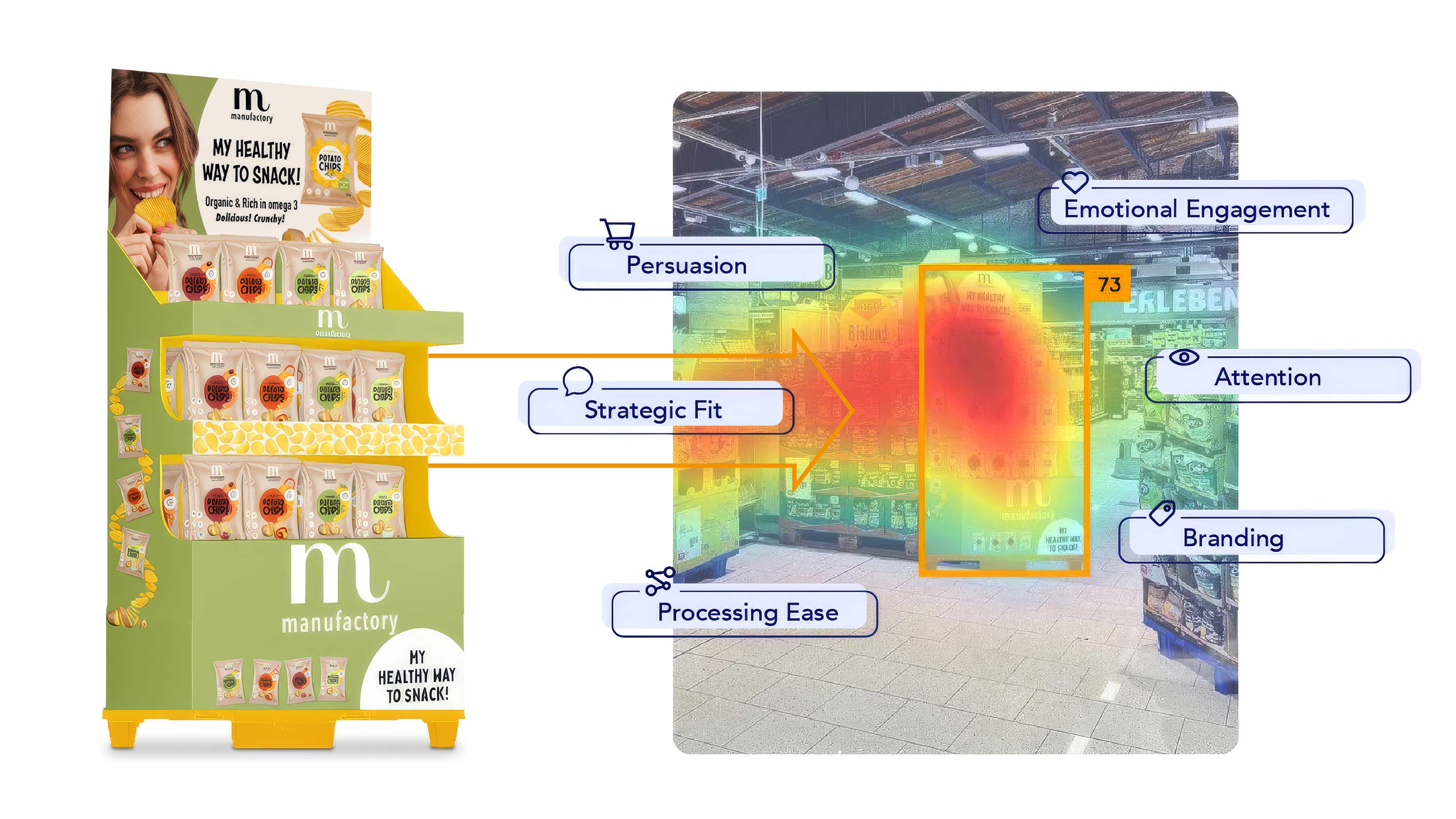
Source: brainsuite.ai
An integrated development and testing process is crucial here. The starting point consists of shoppers, shopping missions, brands, retail channels, and desired behavioral changes. From this, the message, design, and placement are developed. Predictive eye tracking can be used to assess visual attention guidance even during this process. The results are immediately incorporated into the next design iteration. Additional research methods can be used to supplement the analysis where the questions go beyond visual attention.
This is where EBERLE and Brainsuite complement each other. EBERLE combines brand strategy, shopper insights, and design with technical and economic implementation at the point of sale. Brainsuite complements this process with data-driven analysis of visual attention, making it possible to systematically compare different display options at an early stage.
The result is not just a display that looks good in a presentation. It is a point-of-sale solution that is developed based on a clear activation objective, systematically optimized, and implemented for the real-world retail environment.
Learn more about our services as a POS marketing agency
POS activation refers to activities at the point of sale that help shoppers recognize, categorize, and select a product. These include, among other things, POS displays, promotions, and secondary placements.
A good POS display combines brand presence, product benefits, and a clear visual hierarchy. It should not only attract attention but also make it easier for customers to make a specific purchasing decision.
The starting point is the question of what decision the display is intended to support in which shopping situation. The message, design, and placement are derived from this and then evaluated for their effectiveness.
Predictive Eye Tracking uses AI to predict which areas of a visual design are likely to attract attention. This allows POS displays to be optimized based on data even during the development phase.
A display can catch the eye without successfully conveying the brand, product benefits, or promotional message. It is therefore crucial where attention is directed and whether it supports the activation goal.
Ideally, this should be done during the development phase. This allows different variants to be compared and optimized early on, before prototypes, production, and rollout incur high costs.
Was this article helpful for you? Do you have any questions or would you like to make an appointment? Simply contact us and let’s find out together how we can help you quickly.














 back
back
 +49 7171 925290
 kontakt@eberle-werbeagentur.de

